
Surface Finish in Custom PCB Fabrication
The success of a PCB assembly is closely related to the quality of solder joints. Surface finishes that promote good wetting and prevent oxidation protect copper traces from environmental contaminants, increasing the reliability of the assembly. There are many types of surface finish to choose from, including hot air solder leveling (HASL), immersion silver, and electroless nickel immersion gold (ENIG). Choosing the right finish depends on the end application and design process of the circuit board.
During the production of a PCB, an experienced technician performs visual inspections to check for any imperfections or flaws in the finish. Then, the finished board is exposed to a controlled soldering environment to evaluate the wetting and adhesion of solder. Solderability testing also involves examining the PCB for defects like solder bridges, voids, and incomplete joints that can degrade the performance of the finished assembly.
A poor surface finish can cause problems with the assembly of the printed circuit boards, such as shorts between the conductive traces and the copper base. The surface finish must be compatible with the etch resist that covers the surface of the copper, and the solder mask material that will cover the conductive traces. Incompatibilities can result in improper solder mask adhesion and the formation of brittle intermetallic layers that hinder the integrity of the solder joint.
There are several different PCB surface finishing processes, and the best finish depends on the desired design, manufacturing process, and cost of the finished product. For example, HASL is an inexpensive and readily available finish that consists of depositing a layer of molten tin onto the copper. However, it does not provide the same level of protection against oxidation as other finishes. It is also not suitable for high-performance applications that require fine-pitch components and complex geometries.
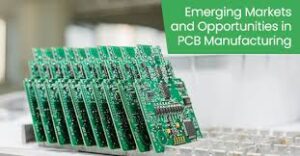
The Significance of Surface Finish in Custom PCB Fabrication
Another option is ENIG, which is an expensive but durable finish that consists of a layer of gold covering an electroless nickel layer. The nickel prevents copper diffusion from the base conductor, while the gold layer creates a low contact resistance and provides superior corrosion protection. It is also a good choice for high-reliability applications that require multiple reflow cycles, such as aerospace and military electronics.
A more environmentally friendly option is organic solderability preserver (OSP), which is an inexpensive and safe process that deposits a thin layer of an organometallic compound directly on the copper surface. It is also a reliable choice for high-reliability applications that require an extended shelf life. It does not have the toxicity levels or consumption of energy associated with other surface finishes, and it is ideal for lead-free PCBs and applications that require a high level of solderability.